
















Enterprise video streaming: when to build and when to buy




Add video without building the stack
Enterprise video streaming has to encode, deliver, protect, play, and measure video reliably at scale, the kind of load where a buffering launch or a leaked file gets expensive fast. Getting there is a build-or-buy choice, and the right answer depends on your team: some build the pipeline in-house for full control, some buy a managed API to ship in days, and plenty land in between. In this guide, we start with what that bar actually requires, walk both paths on cost and timeline, and finish with a calculator you can stress-test on your own numbers.
Key takeaways
- Enterprise video streaming is a stack: ingest and transcoding, global delivery, protection, a player, and analytics, each of which has to hold at scale.
- Building it means running an encoder, a multi-region CDN, a DRM license service, and a player you maintain, plus the security and compliance work around them.
- Buying a managed API turns most of that into a usage bill and goes live in days. The tradeoff is less low-level control.
- The money question has two axes people forget: time-to-ship and ongoing maintenance, well beyond the first invoice.
- Build when video is your product or you have requirements no vendor meets. Buy when video supports the product and time-to-ship matters. Run the numbers below before you commit either way.
What enterprise video streaming requires
Consumer uploads and a share link don’t clear the enterprise bar. Before comparing paths, get specific about what “enterprise” adds on top of plain video hosting. Five things have to hold at once, and each one is a project in its own right.
Scale and reach
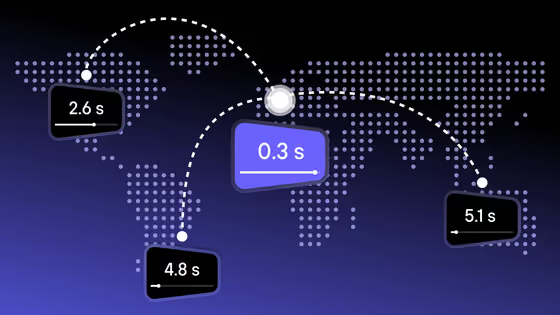
An enterprise audience is global and uneven. A product launch or all-hands might draw thousands of concurrent viewers across continents, on connections that range from office fibre to a phone in a train tunnel. Serving that from a single origin buffers immediately. It needs adaptive bitrate streaming, where each viewer’s player picks the resolution its connection can sustain, delivered over a CDN with points of presence close to the audience. Getting adaptive delivery smooth under a load spike is its own discipline, and it’s the part users notice first when it fails.
Security and content protection
Internal and paid video carries risk from the moment it exists. The baseline is encryption in transit and at rest, so a stored file or an intercepted stream is useless on its own. On top of that comes access control tied to your identity system, and multi-DRM (Widevine and FairPlay, plus PlayReady for older Windows and consoles) for anything that shouldn’t be downloadable at all. Signed, expiring links and domain rules stop a shared URL from quietly becoming a public one. Miss a layer and you’ve protected the page while leaving the file grabbable.
Governance and compliance
Regulated teams have to answer where video lives, who touched it, and how long it’s kept. That means data residency in a named region, audit logs, retention policies, and, for many buyers, formal attestations such as SOC 2, ISO 27001, or a signed DPA. This area varies more than any other, and the gap between “we encrypt data” and “we hold a current SOC 2 report” is exactly where procurement stalls. Treat compliance as a checklist to verify in writing per vendor, and get the specific certificate, region, and DPA confirmed before you design around them.
Integrations
Enterprise video rarely lives on its own page. It embeds into an LMS for training, a Teams channel for internal comms, a CRM for sales enablement, or a customer-facing portal. Each of those wants a clean embed and an API to attach a video to the right record. A platform that only offers a public share page forces glue code around every use case, and that glue becomes maintenance of its own.
Analytics and reliability
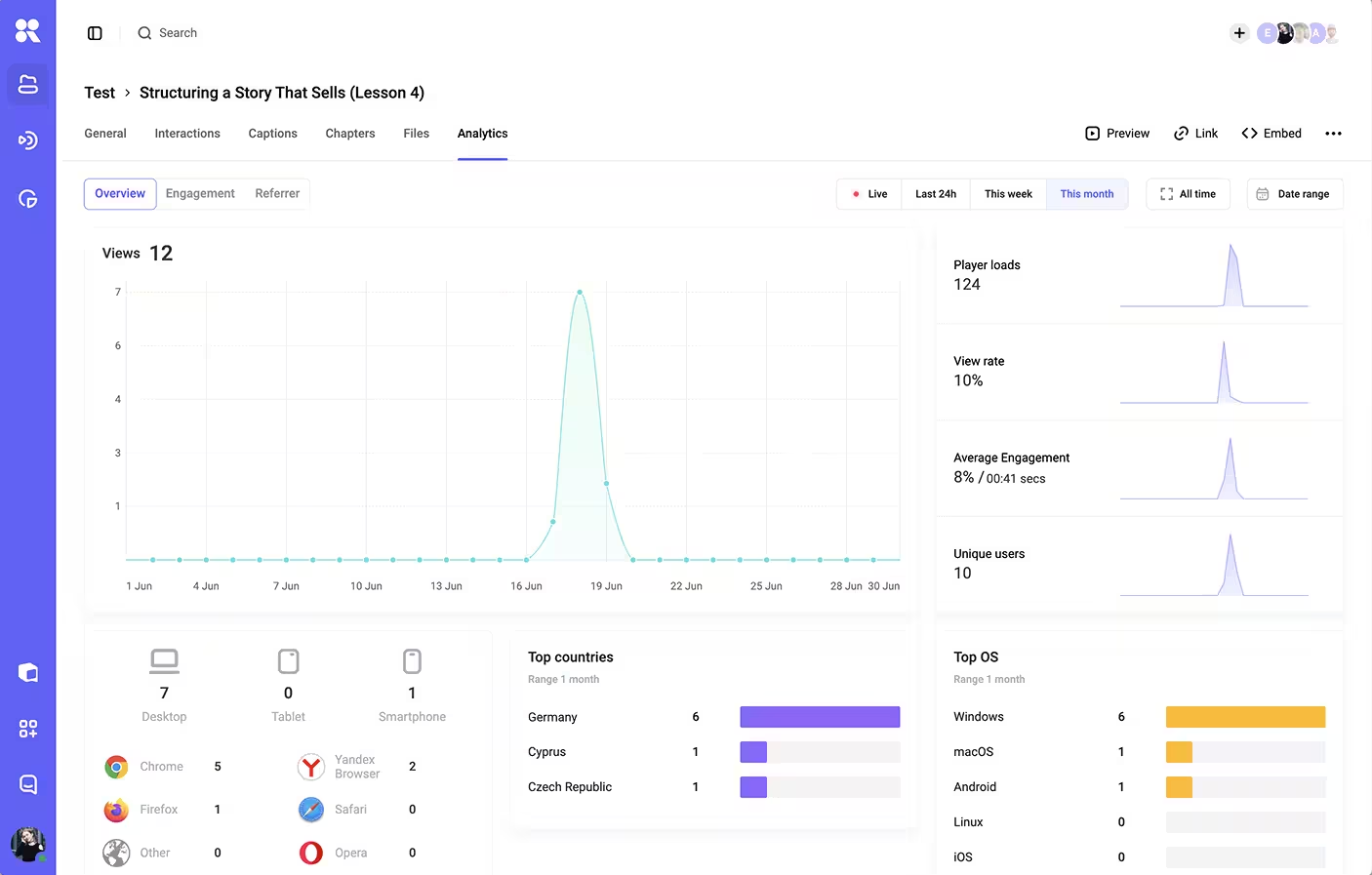
Finally, the data has to flow back: who watched, how far they got, and where they dropped. For training that feeds completion tracking; for marketing it feeds attribution. Underneath all of it is uptime, because an enterprise event that buffers or drops is a visible failure with a cost attached. Reliability at scale is the quiet requirement that only shows up when it’s missing.
The build path: what you run yourself
Building the video layer yourself means owning a full system. To serve one uploaded file well to that global, uneven audience, you run and maintain each of these pieces:
- Ingest and transcoding. Accept arbitrary source files (an MP4 from marketing, a MOV off a phone) and produce several resolutions, because one rendition can’t serve every connection. That’s an encoding fleet you provision, queue, and scale under bursty upload load.
- Packaging and delivery. Segment each rendition for HLS, distribute it across a multi-region CDN with capacity near your viewers, and keep adaptive switching smooth as concurrency climbs. CDN contracts, cache tuning, and egress-cost management come with it.
- Protection. Encrypt storage and transport, sign and expire playback URLs, enforce domain rules, and run a DRM license service across Widevine, FairPlay, and PlayReady, each with its own integration and renewal.
- A player. Build and maintain one that handles HLS, captions, DRM handshakes, fullscreen, picture-in-picture, and the quirks of every browser and mobile OS, then keep it working as those platforms change.
- Analytics. Capture view and engagement events at scale, store them, and tie them to your own users and systems.
Each of those is a specialized area. Together they’re a platform team, standing behind a feature most companies treat as one line on a product spec.
The real cost of building
The first invoice is the smallest part of the number. Building carries three costs that a monthly platform fee hides, and all three compound over time.
The first is time-to-ship. A credible pipeline is quarters of engineering before a single user watches a single video. That delay has a cost of its own: a feature that could ship this quarter waits three, and the roadmap absorbs the difference.
The second is maintenance. Browsers change, DRM SDKs update, CDNs revise pricing, codecs move on, and mobile OS releases break playback edge cases. The pipeline needs a standing team to keep it working, so the cost never drops to zero after launch. It settles into a permanent line item.
The third is opportunity cost, and it’s the largest for most teams. Every engineer on video encoding is an engineer not on the product your company sells. When video supports the product, the months spent standing up infrastructure are months not spent on the thing customers pay for.
None of this argues that building is wrong. It argues that the build number is a team and a timeline, and it belongs in the comparison at full weight.
The buy path: what a managed platform includes
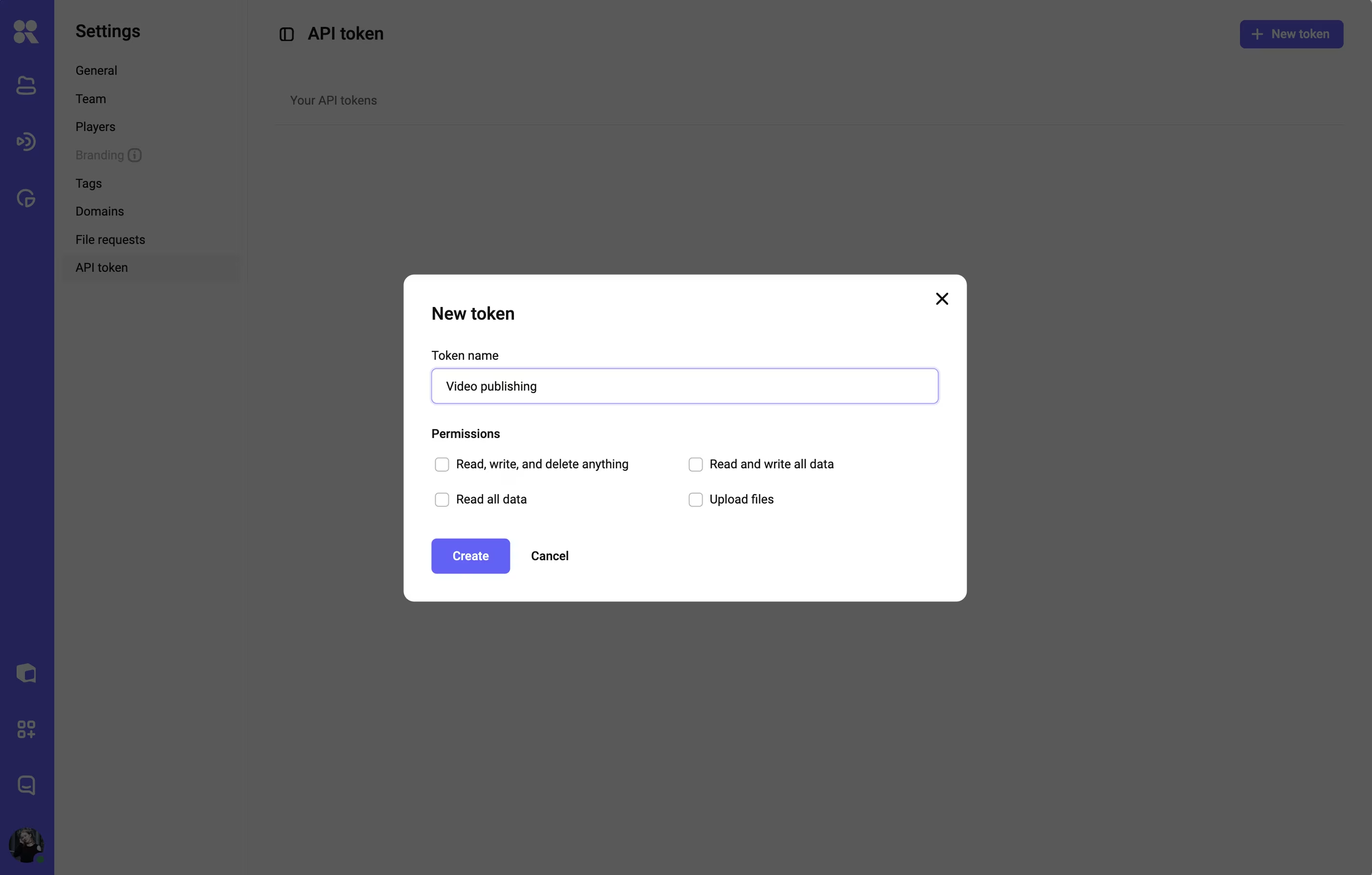
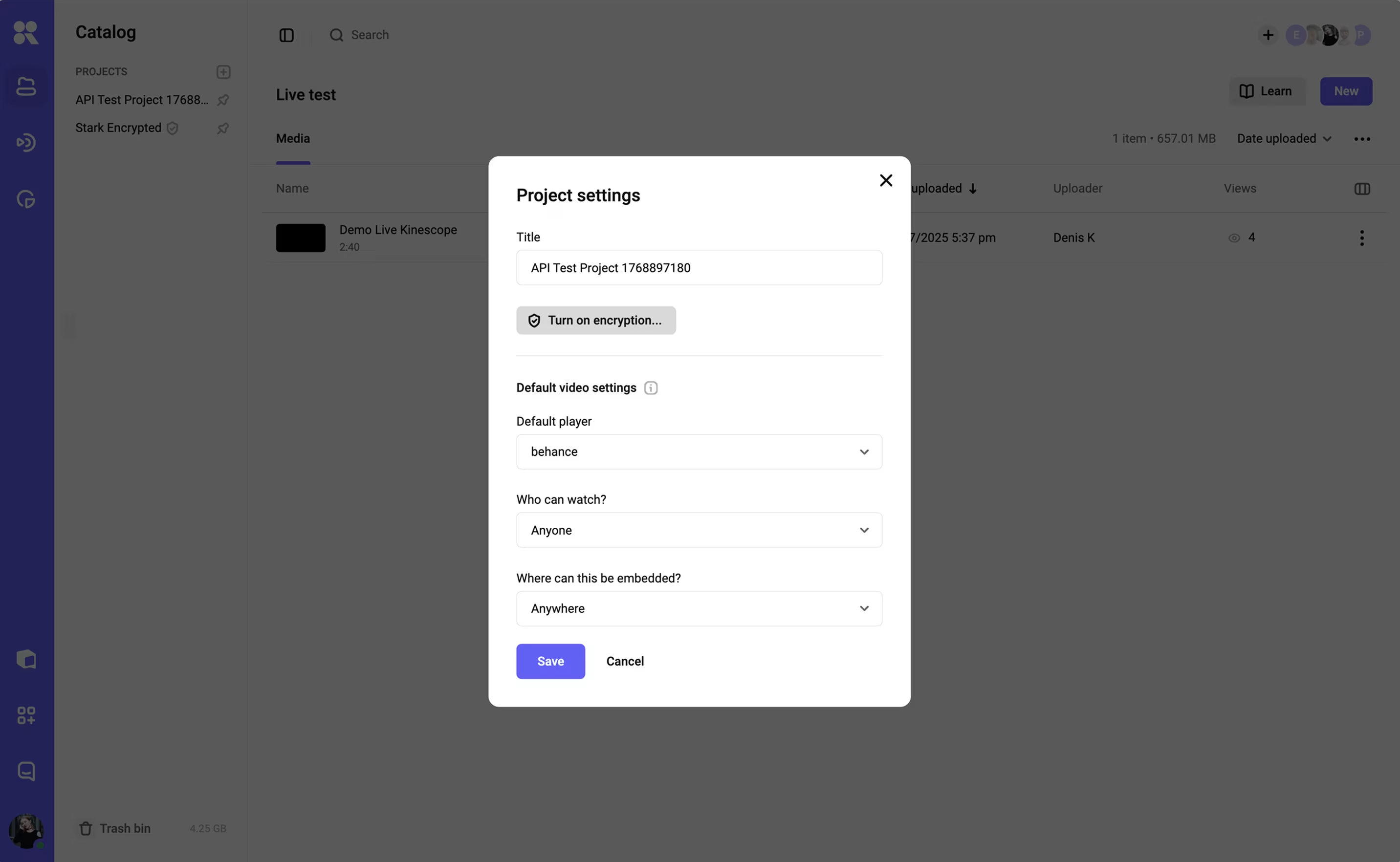
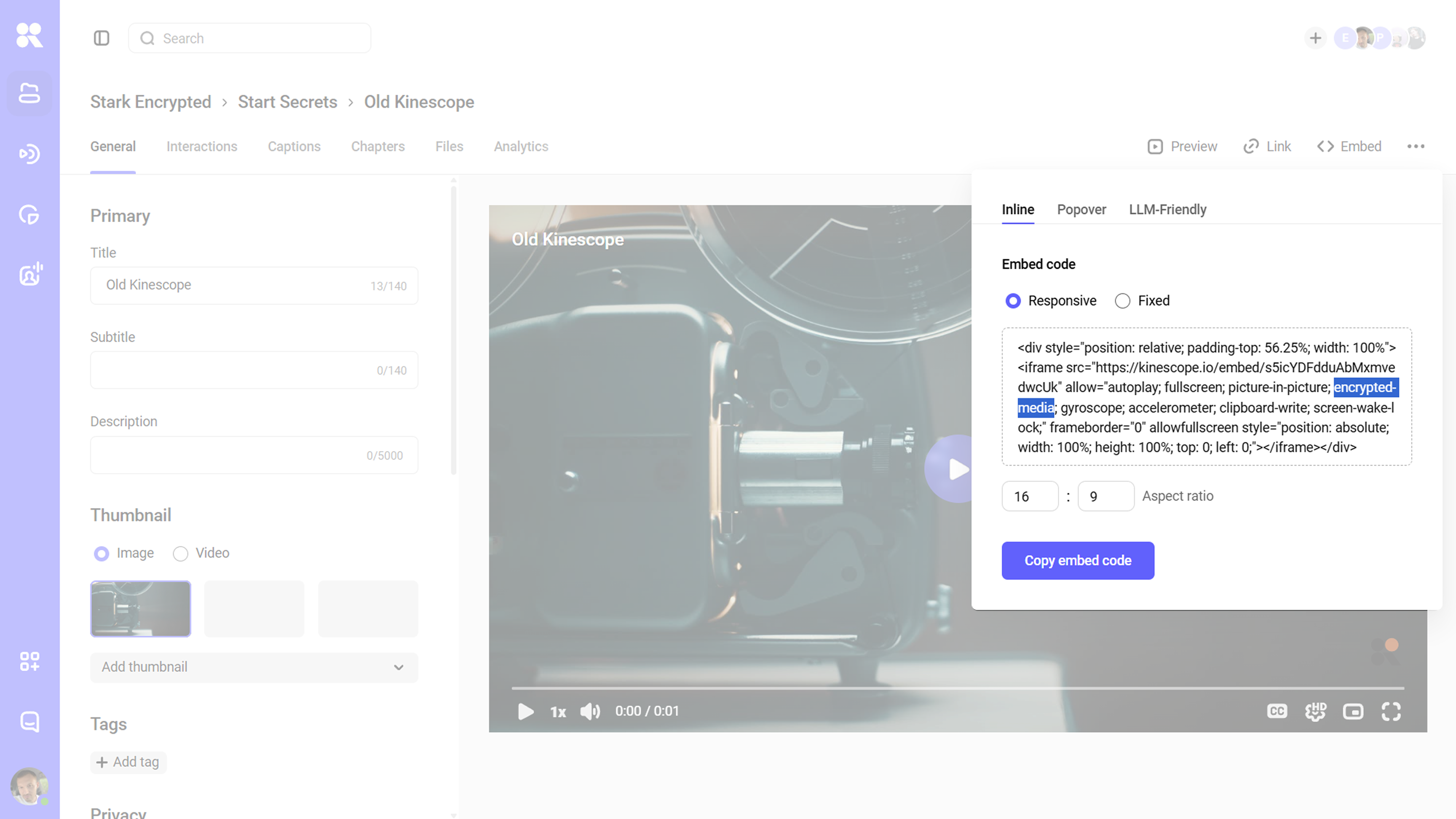
Buying moves the whole stack behind an API. Upload a file, and encoding, storage, CDN delivery, DRM, the player, and analytics arrive as one service you call. A video hosting API handles the flow in a few requests: authenticate, upload, embed the returned video, and listen for a webhook when processing finishes. The player is an embed you drop in and drive from JavaScript, and open-source SDKs wrap it for React, iOS, Flutter, and more — the developer hub has the install command for each one and a live Player API demo. The same embed carries the video’s access rules, so it stays private or DRM-protected wherever you place it.
The pieces that took a platform team to build arrive configured. Adaptive HLS, a global CDN, multi-DRM, signed links, domain rules, and watermarking are on by default. On Kinescope they’re usage-based from €10 a month plus €0.03 per gigabyte stored and delivered, with DRM included as standard, so the protection paid content needs is part of the same API and not a separate enterprise line. For teams that want to generate a client, the full API spec and docs are public.
What buying gives up
A managed platform is a set of good defaults, so its honest cost is control. You take its encoding ladder, its player’s release cycle, and its roadmap. Deep, unusual customization is where a vendor’s abstractions can stop short: a bespoke codec, an exotic packaging format, or an on-prem-only delivery mandate may be things the platform simply doesn’t do. Compliance is the other place to look closely. A platform can offer strong encryption and DRM without holding the specific certificate your procurement team requires, so confirm SOC 2, ISO 27001, residency, and a DPA against your own list before you rely on a managed service for them.
Build versus buy at a glance
Here’s how the two paths line up across the dimensions that tend to decide it:
| Dimension | Build it yourself | Buy a managed API |
|---|---|---|
| Time to first video | Quarters | Days |
| Upfront cost | High (team + infrastructure) | Near zero |
| Ongoing cost | Standing team + infrastructure | Usage-based bill |
| Scale and CDN | You provision and tune | Included |
| DRM and protection | You run a license service | Included |
| Maintenance | Yours, permanently | The vendor’s |
| Deep customization | Full control | Vendor’s defaults |
| Compliance ownership | Yours to build and prove | Verify per vendor |
The rows that most often tip it are time-to-ship and ongoing maintenance, and those are exactly what the calculator below puts numbers on.
Cost and effort, side by side
The two paths spend money on different shapes. Building front-loads a large cost and a long wait, then settles into a steady maintenance line. Buying is a smaller, usage-shaped bill that starts the week you sign up and grows with delivery. Where the two cross depends entirely on your inputs, so here they are as a model you can drive: set your team size, engineer cost, months to ship, and infrastructure against storage, delivery, and a per-gigabyte rate, and read the totals over the horizon you care about.
Build vs buy: run your own numbers
Set the inputs for each path and a horizon; the totals and break-even update live.
Build it yourself
Buy a managed API
Build
€0
Buy
€0
—
Approximate figures for planning — the Buy side is priced on Kinescope’s rates (€10/mo base plus €0.03 per GB stored and delivered). It counts money only: build-team payroll, the infrastructure bill (CDN, storage, encoding, and the DRM license service), and usage fees. Two things that often weigh more stay off the ledger: the value lost while a build ships in quarters instead of days, and the operational risk of running infrastructure yourself — an outage or a leaked launch the bill misses. Engineer cost is fully loaded per month.
The calculator counts money alone. The two things it can’t price, time-to-ship and the risk of running infrastructure yourself, usually weigh heaviest in the decision, so read the totals with those beside them.
When building is the right call
Building earns its cost in a few real cases. The clearest is when video is your product: a streaming service, a creator platform, a video-first tool where the pipeline is the thing you sell and control is the whole point. The second is a hard requirement no vendor meets, such as a specific packaging format, an on-prem-only mandate, or a compliance regime you must own and prove end to end. The third is scale that’s large and specialized enough that owning the infrastructure beats any usage bill, which tends to be true only at the size where you’re effectively a streaming company already.
If one of those describes you, the engineering months are an investment in your core product, and the control you get back is worth the maintenance you take on. Just enter that case into the comparison honestly, with the standing team counted in full.
When buying wins
For most teams, video supports the product, and the managed path wins on the axes that matter. Time-to-ship drops from quarters to days. Cost becomes a predictable usage line with no upfront platform build. Protection and delivery arrive configured, so DRM, signed links, and a global CDN are settings instead of subprojects. And maintenance moves off your plate, which is the cost that quietly grows the longer you own a pipeline.
Buying also front-loads less risk. The analytics and access controls you would have built come with the service, and a small first project (upload a handful of videos, embed them, wire one webhook) tells you inside a week whether the platform fits.
When the goal is secure, scalable video inside a product you already sell, that’s the faster and usually cheaper route.
A short checklist before you decide
Before committing either way, answer these in order. They tend to settle the question faster than a feature grid.
- Is video the product or a supporting feature? If it’s the product, weigh building seriously. If it supports the product, weigh buying first.
- What’s your time-to-ship pressure? A quarter of runway points to buy; a multi-year platform bet can absorb a build.
- What must you own for compliance? List the exact certificates, regions, and agreements, then verify them against any vendor before designing around them.
- What standing team can you spare? Building is a permanent line, not a one-time sprint. With no one to staff maintenance, you can’t build.
- What does the calculator say at your real horizon? Run your own numbers above, then add the weight of time and risk to whatever it shows.