




















Video glossary
Plain-English definitions of the streaming, encoding, delivery and security terms behind modern video — written and kept current by the team building Kinescope.
Start here · most read
Streaming
Adaptive Bitrate (ABR)
Automatically adjusts video quality in real time to match each viewer’s connection speed — smooth playback from 480p to 4K with no buffering.
Read →Manifest
A small index file (.m3u8 or .mpd) that lists every available rendition and segment so the player knows what it can request.
Read →Buffering
When playback pauses to load more data. ABR exists largely to prevent it by stepping quality down before the buffer empties.
Read →Latency
The delay between a moment happening and a viewer seeing it. Critical for live — Low-Latency HLS brings it down to 2–5 seconds.
Read →Protocols
Encoding
Transcoding
Re-encoding a source video into multiple resolutions and bitrates so a player can switch between quality levels on the fly.
Read →Bitrate
The amount of data used per second of video. Higher bitrate means more detail and a larger file; the core lever behind streaming quality.
Read →Codec
The algorithm that compresses and decompresses video — H.264, H.265 (HEVC) and AV1 are the most common in modern streaming.
Read →720p
High definition at 1280×720 — 921,600 pixels per frame. The entry point to HD and the fallback rung below Full HD.
Read →1080p (Full HD)
Full HD at 1920×1080 — just over two million pixels. The default target for course, sales and web video.
Read →4K (2160p)
Ultra HD at 3840×2160 — four times the pixels of Full HD, and the point where codec choice starts paying for itself.
Read →SD (Standard Definition)
Standard definition — video below the HD line, in practice 480p (854×480) or smaller. The fallback tier of the resolution ladder.
Read →HD (High Definition)
High definition — 720p and up, with 1080p as Full HD. The default quality most web and course video targets.
Read →480p
Standard-definition video, 480 pixels tall — 854×480 in 16:9. The fallback rung of the adaptive ladder for slow or metered connections.
Read →Resolution
The pixel dimensions of a video frame — 480p, 720p, 1080p, 2160p (4K). Determines how sharp the picture looks on a given screen.
Read →Delivery
CDN (Content Delivery Network)
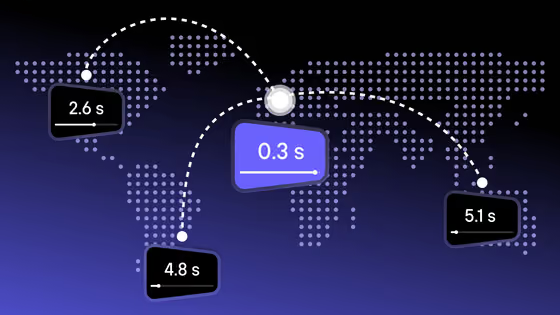
A global network of edge servers that caches video close to viewers, cutting latency and absorbing traffic spikes.
Read →Live stream
Real-time video delivered as it is captured, transcoded and segmented on the fly — webinars, events, broadcasts.
Read →VoD (Video on Demand)
Pre-recorded video a viewer can start any time — the opposite of live. Transcoded once, then served from the CDN on request.
Read →Security
Signed URL
A playback link carrying an expiry and a cryptographic token — it stops working once the window closes, and a tampered link never works.
Read →Watermarking
A mark burned into the frames. It prevents nothing — it makes a leaked copy point back at the account it came from.
Read →DRM
Encryption of the video file plus a licence server that issues a per-session key — so a downloaded copy stays unplayable.
Read →Multi-DRM
Serving one encrypted library through Widevine, FairPlay and PlayReady at once — no single DRM system covers every browser and device.
Read →HDCP
Link-level encryption between a video source and the display over HDMI or DisplayPort — the layer that blocks a capture card placed in between.
Read →Video access control
The rules that decide who may start a video: approved domains, expiring signed links, geo and IP limits, passwords, one-time codes and SSO.
Read →No terms match . Try a broader word — a format, a resolution, or “DRM”.
FAQ
Can’t find the answer you need? Check out our Help Center.