

















VoD (Video on Demand)
Pre-recorded video a viewer starts whenever they like — the on-demand replay, the course lesson, the product video. The opposite of live.
VoD is pre-recorded video that a viewer starts, pauses and scrubs whenever they choose — course lessons, product clips, webinar replays — transcoded once ahead of time and then served from a CDN on request.
What is VoD (Video on Demand)?
VoD — Video on Demand — is pre-recorded video that a viewer can start at any time, as opposed to a live streamLive streamReal-time video delivered as it is captured, transcoded and segmented on the fly — webinars, events, broadcasts.Open definition → that plays in real time. Course lessons, product pages, webinar replays and marketing clips are all VoD: the file exists before anyone watches it.
The defining trait is control on the viewer's side — they choose when to press play, and they can pause, rewind and scrub. That's only possible because the whole video is prepared and stored in advance, so any point in the timeline is instantly available.
Technically, VoD uses the same streaming stack as live — transcodingTranscodingRe-encoding a source video into multiple resolutions and bitrates so a player can switch between quality levels on the fly.Open definition → into an adaptive ladder, HLSHLS (HTTP Live Streaming)Apple’s adaptive streaming protocol. Uses .m3u8 manifests and segmented delivery; supported on every browser, device and smart TV.Open definition → segments, a CDNCDN (Content Delivery Network)A global network of edge servers that caches video close to viewers, cutting latency and absorbing traffic spikes.Open definition → and an adaptive player — minus the real-time constraint. Because the file is prepared ahead of time, there's no latencyLatencyThe delay between a moment happening and a viewer seeing it. Critical for live — Low-Latency HLS brings it down to 2–5 seconds.Open definition → pressure; the priorities are storage, instant start, quality, and access control.
Where VoD shows up
Most business video is VoD, even when people don't call it that:
Every lesson behind a login is VoD — often gated with access controlVideo access controlThe rules that decide who may start a video: approved domains, expiring signed links, geo and IP limits, passwords, one-time codes and SSO.Open definition → and watched on any device, at the learner's pace.
Explainers, demos and product-page video are VoD embedded on a site, where load speed and a clean, ad-free player matter for conversion.
A recorded live streamLive streamReal-time video delivered as it is captured, transcoded and segmented on the fly — webinars, events, broadcasts.Open definition → becomes VoD — an evergreen asset that keeps generating views and leads long after the event.
Training libraries, onboarding and confidential material — VoD with DRMDRMEncryption of the video file plus a licence server that issues a per-session key — so a downloaded copy stays unplayable.Open definition →, watermarkingWatermarkingA mark burned into the frames. It prevents nothing — it makes a leaked copy point back at the account it came from.Open definition → and per-viewer analytics.
VoD business models
| Model | How it's paid | Example |
|---|---|---|
| AVOD | Ad-supported, free to viewer | Ad-funded video portals |
| SVOD | Subscription | Streaming services, membership sites |
| TVOD | Transactional (pay per title / rental) | Buy or rent a single video |
These describe how VoD is monetised, not how it's delivered — the underlying technology is the same for all three.
How VoD is delivered
The source is transcodedTranscodingRe-encoding a source video into multiple resolutions and bitrates so a player can switch between quality levels on the fly.Open definition → into an adaptive ladder of resolutionsResolutionThe pixel dimensions of a video frame — 480p, 720p, 1080p, 2160p (4K). Determines how sharp the picture looks on a given screen.Open definition → and bitratesBitrateThe amount of data used per second of video. Higher bitrate means more detail and a larger file; the core lever behind streaming quality.Open definition → — done a single time, then reused for every viewer.
The renditions and a manifestManifestA small index file (.m3u8 or .mpd) that lists every available rendition and segment so the player knows what it can request.Open definition → live on the origin as the authoritative copy.
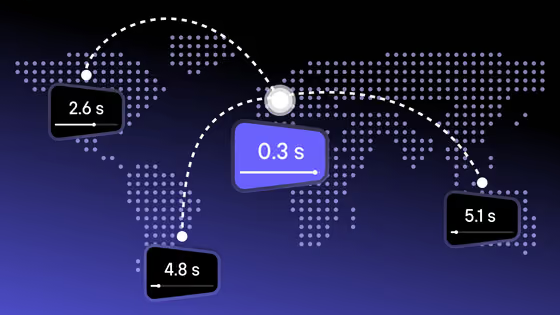
On play, segments are cached and served from a CDNCDN (Content Delivery Network)A global network of edge servers that caches video close to viewers, cutting latency and absorbing traffic spikes.Open definition → edge near the viewer, and the adaptive player switches quality to fit their connection.
Further reading
- Video on demand — Wikipedia — a vendor-neutral overview.