













DRM
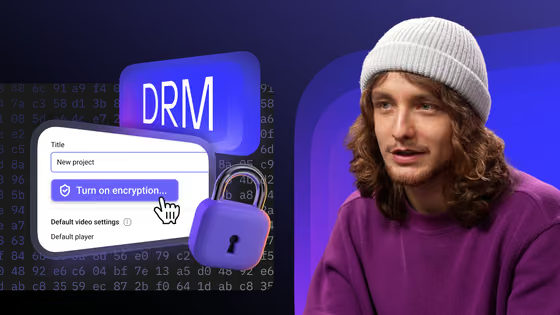
Digital Rights Management — encryption applied to the video file itself, plus a licence server that hands each viewing session a temporary key. Without that key the file on disk is unplayable data, which is what stops a download from becoming a copy.
DRM locks the video file itself and hands out a one-time decryption key per viewing session, so a copy someone downloads is just unplayable encrypted data without an authorised licence.
What is DRM?
DRM is a system for controlling what happens to a media file after it has been delivered. For video it means two things working together: the content is encrypted during packaging, and a separate licence server decides — per viewer, per session — whether to release the key that decrypts it.
That split is the whole point. Access controlVideo access controlThe rules that decide who may start a video: approved domains, expiring signed links, geo and IP limits, passwords, one-time codes and SSO.Open definition → decides who may start playback; DRM decides what the bytes are worth once they have arrived. A file pulled off the wire without a licence is ciphertext, and stays that way.
On Kinescope, DRM means Widevine and FairPlay, included on every paid plan from €10/month and switched on per project.
How video DRM works
During transcodingTranscodingRe-encoding a source video into multiple resolutions and bitrates so a player can switch between quality levels on the fly.Open definition →, every rendition is encrypted. Common Encryption (CENC) lets one packaged copy serve several DRM systems, so you do not store the library three times.
When the viewer presses play, the player asks a licence server for a key, passing along whatever identity your application supplies.
The licence server applies your rules — is this viewer entitled, on how many devices, for how long — and issues a key bound to that session.
The key never reaches your JavaScript. It is handed to a protected module inside the browser or operating system, which decrypts frames as they play.
Browsers expose this through Encrypted Media Extensions (EME), a standard API. The decryption itself happens in the platform's Content Decryption Module — code the page cannot read, which is what makes the scheme meaningfully different from obfuscation.
The three DRM systems
There is no single DRM. Three vendor systems split the device landscape, and covering an audience means supporting more than one.
| System | Owner | Where it plays | Usual pairing |
|---|---|---|---|
| Widevine | Chrome, Edge, Firefox, Android, many smart TVs | DASHDASHDynamic Adaptive Streaming over HTTP — an open ISO standard using .mpd manifests, common for DRM-protected premium content.Open definition → | |
| FairPlay | Apple | Safari, iOS, iPadOS, macOS, tvOS | HLSHLS (HTTP Live Streaming)Apple’s adaptive streaming protocol. Uses .m3u8 manifests and segmented delivery; supported on every browser, device and smart TV.Open definition → |
| PlayReady | Microsoft | Windows, Xbox, a range of smart TVs and set-top boxes | DASHDASHDynamic Adaptive Streaming over HTTP — an open ISO standard using .mpd manifests, common for DRM-protected premium content.Open definition → / Smooth |
Widevine and FairPlay together cover the overwhelming majority of consumer devices. PlayReady matters mainly for broadcast-style and living-room delivery.
Viewers install nothing: all three are built into the browsers and operating systems people already use. From their side, protected playback looks exactly like unprotected playback.
What DRM stops — and what it does not
DRM is precise about the problem it solves. Being honest about the edges is more useful than a promise of total protection.
| Threat | Does DRM stop it? | Why |
|---|---|---|
| Downloading the file with an extension or VLC | Yes | What lands on disk is encrypted and useless without a licence |
| Harvesting the CDNCDN (Content Delivery Network)A global network of edge servers that caches video close to viewers, cutting latency and absorbing traffic spikes.Open definition → link and replaying it | Yes | The stream still requires a per-session key |
| Re-uploading your embed on another site | Partly | Pair DRM with domain restrictions — that rule lives outside the encryption |
| Recording the screen | Partly | Blocked where the OS allows it; elsewhere a dynamic watermarkWatermarkingA mark burned into the frames. It prevents nothing — it makes a leaked copy point back at the account it came from.Open definition → makes the leak traceable |
| A camera pointed at the monitor | No | Nothing prevents this — watermarking is what makes it attributable |
That last row is why serious setups layer controls rather than relying on one: DRM for the file, watermarking for attribution, signed linksSigned URLA playback link carrying an expiry and a cryptographic token — it stops working once the window closes, and a tampered link never works.Open definition → and domain rules for distribution.
DRM versus the other protections
The words get used interchangeably in marketing, so it is worth separating them:
Controls who reaches the page. Once playback starts it has no further say.
Stops hotlinking and stale links. Does nothing about a download taken while the link is valid.
Keeps the embed from playing on sites you did not approve. Silent about what happens on your own page.
Does not prevent anything — it identifies the viewer a leaked copy came from.
The only one that makes the file itself worthless without an active, authorised session.
Further reading
- Digital rights management — Wikipedia — a vendor-neutral overview.
- Video tutorials — DRM encryption switched on, shown step by step.
- How to stop videos being downloaded — the practical playbook.
- Secure video hosting with DRM — how Kinescope implements it.
- Video access control — domain, token and session rules.
- What is anti-piracy? — methods that actually work.
- Anti-piracy for video — DRM alongside watermarking and access rules.