



















CDN (Content Delivery Network)
The global network of edge servers that puts your video close to every viewer — so it starts fast, plays smoothly, and holds up under a traffic spike.
A CDN is a worldwide mesh of edge servers that keeps copies of your video near viewers, so playback starts fast, stalls less, and survives a traffic spike instead of hammering one distant origin.
What is a CDN (Content Delivery Network)?
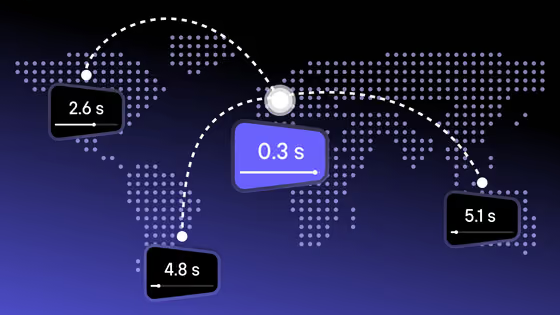
A CDN (Content Delivery Network) is a geographically distributed network of servers that caches copies of your content — video segments, images, files — close to where viewers are. When someone presses play, the video is served from a nearby edge server instead of a single origin that might be thousands of kilometres away.
For video this is not a nice-to-have. Streaming means delivering many short segmentsHLS (HTTP Live Streaming)Apple’s adaptive streaming protocol. Uses .m3u8 manifests and segmented delivery; supported on every browser, device and smart TV.Open definition → in quick succession; the closer the server, the lower the latencyLatencyThe delay between a moment happening and a viewer seeing it. Critical for live — Low-Latency HLS brings it down to 2–5 seconds.Open definition → and the less chance of bufferingBufferingWhen playback pauses to load more data. ABR exists largely to prevent it by stepping quality down before the buffer empties.Open definition →. A CDN also absorbs demand: a video that suddenly gets thousands of concurrent viewers is served from hundreds of edges, not from one overloaded machine.
How a CDN works
Your transcodedTranscodingRe-encoding a source video into multiple resolutions and bitrates so a player can switch between quality levels on the fly.Open definition → renditions and manifestsManifestA small index file (.m3u8 or .mpd) that lists every available rendition and segment so the player knows what it can request.Open definition → live on the origin (the hosting layer) — the authoritative copy.
The first viewer in a region triggers the edge to fetch and cache the needed segments. Everyone after them is served from that cache — fast, and without touching the origin.
Viewers are directed to the closest healthy edge automatically, so a viewer in São Paulo and one in Berlin each stream from a server near them.
Spikes are spread across the whole edge network, so concurrency scales with the CDN rather than being capped by a single server.
The key efficiency metric here is the cache hit ratio — the share of requests served from the edge rather than fetched from origin. The higher it is, the faster viewers get their video and the less load (and cost) lands on the origin. Popular content warms the cache and keeps that ratio high.
CDN vs. hosting
| Aspect | Hosting (origin) | CDN (edge) |
|---|---|---|
| Role | Stores the master copy | Distributes copies near viewers |
| Optimised for | Storage, management, processing | Speed and scale of delivery |
| Without it | Nowhere to keep the video | Slow starts, buffering, spikes overwhelm the origin |
| On Kinescope | Both, in one platform — hosting + owned CDN | |
Owned vs rented CDN
Not all "our CDN" claims mean the same thing. Most video platforms rent capacity from a third party (Cloudflare, Fastly, Akamai) and resell it; a few build and run their own network. The difference shows up in price and in who fixes problems.
| Aspect | Rented (third-party) | Owned |
|---|---|---|
| Pricing | Often a reseller markup | No middleman margin |
| Escalations | Cross a vendor boundary | One team owns the whole chain |
| SLA | Depends on the vendor's | Set and honoured directly |
Kinescope runs its own network — points of presence across Latin America, the US, Europe and the CIS — with a 99.98% uptime SLA.
Further reading
- Content delivery network — Wikipedia — a vendor-neutral overview.