














Latency
How far behind real time a stream runs — the difference between a webinar that feels live and one where the chat is 30 seconds ahead of the video.
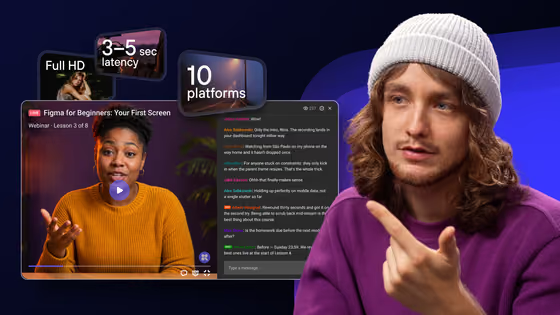
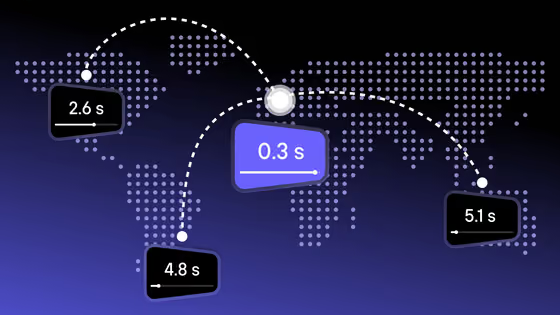
Latency is the delay between a moment happening live and a viewer seeing it on screen; standard HLS runs 10–30 seconds behind, while Low-Latency HLS cuts that to a few seconds.
What is latency?
Latency is the delay between a moment happening in front of the camera and a viewer seeing it on screen. In a live streamLive streamReal-time video delivered as it is captured, transcoded and segmented on the fly — webinars, events, broadcasts.Open definition →, it's the gap between real time and playback — measured in seconds.
For on-demand video it barely matters; a VoDVoD (Video on Demand)Pre-recorded video a viewer can start any time — the opposite of live. Transcoded once, then served from the CDN on request.Open definition → file is already complete, so there's nothing to be "behind". For live it can make or break the experience: if viewers interact through chat, polls or bidding, a 30-second lag means the conversation runs ahead of the video.
Latency is not the same as bufferingBufferingWhen playback pauses to load more data. ABR exists largely to prevent it by stepping quality down before the buffer empties.Open definition →. Buffering is playback pausing to load data; latency is how far behind real time you are. A stream can be perfectly smooth and still 20 seconds late.
The latency tiers
"Low latency" means different things depending on the delivery method. The rough tiers:
| Tier | Typical delay | Method | Good for |
|---|---|---|---|
| Standard HLS | 10–30 s | Regular segments | Broadcasts, one-way events |
| Low-Latency HLS | 2–8 s | Partial segments + server push | Webinars, Q&As, interactive live |
| WebRTC | Under 1 s | Peer real-time transport | Video calls, two-way conversation |
Most interactive live sits comfortably in the LL-HLSHLS (HTTP Live Streaming)Apple’s adaptive streaming protocol. Uses .m3u8 manifests and segmented delivery; supported on every browser, device and smart TV.Open definition → range — a few seconds — which balances responsiveness with the reliability of HTTP delivery.
What adds latency
Compressing the live feed into deliverable renditions takes time before anything can ship.
The stream is cut into segments; longer segments are more stable but add delay before each is ready.
Players hold a few segments in reserve before playing to avoid stalls — reserve that also adds latency.
LL-HLS uses partial segments and server push so the player can start a chunk before it's fully written, cutting the delay to a few seconds.
When you need low latency
Chasing the lowest possible latency has a cost: smaller segments and a shallower buffer leave less headroom to absorb a bandwidth dip, so an aggressive low-latency setup can rebuffer more. So match the target to the use case rather than defaulting to "as low as possible":
Webinars, Q&As, live shopping and auctions need a few seconds so chat and reactions stay in sync. LL-HLS is the sweet spot.
Keynotes, conferences and passive viewing don't need real-time; standard HLS buys more stability at scale.
A recorded replay has no real-time reference at all — only start time and smoothness matter.
Further reading
- Apple — HTTP Live Streaming — Low-Latency HLS specification.