


















Buffering
The spinning-wheel pause that kills a viewing session — and the problem most of streaming's core technology exists to prevent.
Buffering is when a video stalls mid-playback because data arrives slower than it plays; the player's reserve of upcoming footage empties, so it pauses to reload before continuing.
What is buffering?
Buffering is when video playback pauses to download more data before it can continue. The player keeps a small reserve of upcoming video (the "buffer"); when data arrives slower than it's played, that reserve empties and playback stalls — the spinning wheel — until enough has loaded to resume.
It usually comes down to one of a few causes: the bitrateBitrateThe amount of data used per second of video. Higher bitrate means more detail and a larger file; the core lever behind streaming quality.Open definition → is too high for the viewer's connection, the server or CDNCDN (Content Delivery Network)A global network of edge servers that caches video close to viewers, cutting latency and absorbing traffic spikes.Open definition → is far away or overloaded, or the video wasn't prepared for adaptiveAdaptive Bitrate (ABR)Automatically adjusts video quality in real time to match each viewer’s connection speed — smooth playback from 480p to 4K with no buffering.Open definition → delivery. Rebuffering is one of the strongest predictors of viewers abandoning a video, which is why so much of streaming's technology exists to avoid it.
Initial buffering vs rebuffering
Not all buffering is equal, and the industry measures the two kinds separately as quality-of-experience metrics.
| Type | When it happens | Metric | Impact |
|---|---|---|---|
| Initial buffering | Before playback starts | Video start time | Viewers abandon before watching |
| Rebuffering | Mid-playback stalls | Rebuffer ratio (% of watch time stalled) | Most damaging — interrupts committed viewers |
A low rebuffer ratio and a fast start time are the two numbers that best predict watch-through — worth tracking in your analytics.
How buffering is prevented
The player steps quality down before the buffer empties, so playback continues at a lower resolutionResolutionThe pixel dimensions of a video frame — 480p, 720p, 1080p, 2160p (4K). Determines how sharp the picture looks on a given screen.Open definition → instead of stalling — then steps back up when the connection recovers.
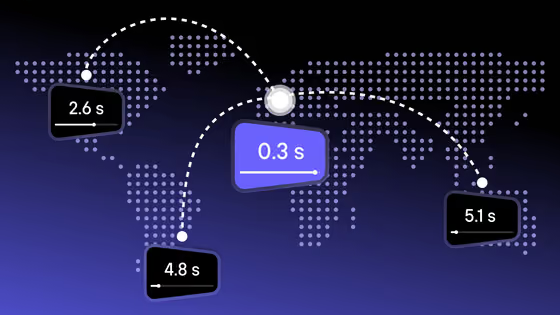
Serving segments from an edge serverCDN (Content Delivery Network)A global network of edge servers that caches video close to viewers, cutting latency and absorbing traffic spikes.Open definition → near the viewer keeps data arriving quickly and reliably, keeping the buffer full even under load.
A well-built rendition ladder gives the player realistic rungs to pick from, so it can always find one the connection can sustain.
Holding a few seconds of video in reserve lets the player ride out short bandwidth dips without stalling — a trade against latencyLatencyThe delay between a moment happening and a viewer seeing it. Critical for live — Low-Latency HLS brings it down to 2–5 seconds.Open definition → on live.
Further reading
- Adaptive bitrate streaming — Wikipedia — the main defence against buffering.