










Live stream
Video delivered in real time as it happens — the webinar, the event, the broadcast — encoded and sent to viewers on the fly.
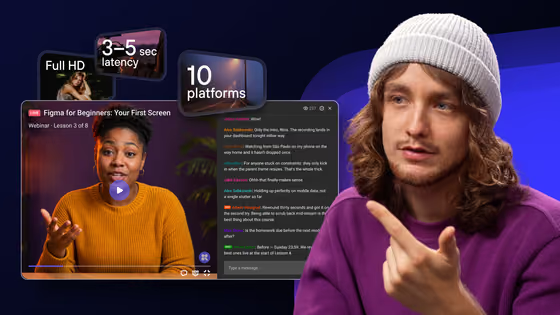
A live stream is video encoded and delivered to viewers in real time as it is captured — the webinar or broadcast they watch as it happens — rather than a file uploaded and played back later.
What is a live stream?
A live stream is video delivered to viewers in real time as it is captured, rather than uploaded in advance. The camera or screen feed is encoded, cut into short segmentsHLS (HTTP Live Streaming)Apple’s adaptive streaming protocol. Uses .m3u8 manifests and segmented delivery; supported on every browser, device and smart TV.Open definition → and sent out continuously, so an audience anywhere can watch an event as it unfolds.
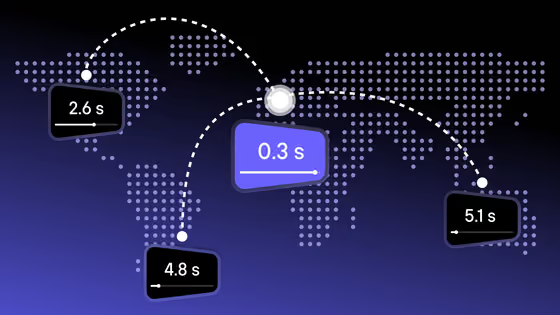
The opposite is video on demand (VoD)VoD (Video on Demand)Pre-recorded video a viewer can start any time — the opposite of live. Transcoded once, then served from the CDN on request.Open definition → — pre-recorded video a viewer starts whenever they like. The two often connect: most live streams are recorded and become a VoD replay afterwards. Live is defined by two hard constraints — latencyLatencyThe delay between a moment happening and a viewer seeing it. Critical for live — Low-Latency HLS brings it down to 2–5 seconds.Open definition → (how far behind real time) and reliability under sudden load.
How a live stream works
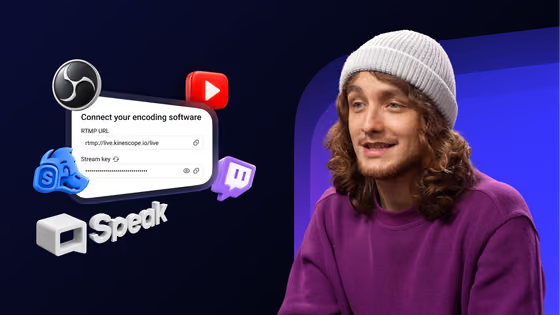
A camera or screen feed goes into an encoder (OBS, vMix, or hardware) that sends it to the platform over RTMP or SRT.
The platform transcodesTranscodingRe-encoding a source video into multiple resolutions and bitrates so a player can switch between quality levels on the fly.Open definition → the incoming feed into multiple quality levels in real time, so the player can adapt to each viewer's connection.
The stream is segmented and served through a CDNCDN (Content Delivery Network)A global network of edge servers that caches video close to viewers, cutting latency and absorbing traffic spikes.Open definition →, which fans it out to viewers near them — the key to scaling to large audiences.
The session is recorded automatically and becomes an on-demand replay when it ends.
Ingest protocols: RTMP, SRT, WebRTC
"Ingest" is how your encoder gets the feed into the platform — separate from how viewers watch it (which is HLS/DASHDASHDynamic Adaptive Streaming over HTTP — an open ISO standard using .mpd manifests, common for DRM-protected premium content.Open definition →). The common options:
| Protocol | Strength | Best for |
|---|---|---|
| RTMP | Universal encoder support | The default for most streams |
| SRT | Reliable over unstable networks (recovers packet loss) | Remote / field production |
| WebRTC | Sub-second, browser-native | Two-way, conversational live |
Whichever you send in on, viewers still receive an adaptive HLS/DASH stream — ingest and playback are two different halves of the pipeline.
Further reading
- Live streaming — Wikipedia — a vendor-neutral overview.