











Multi-DRM
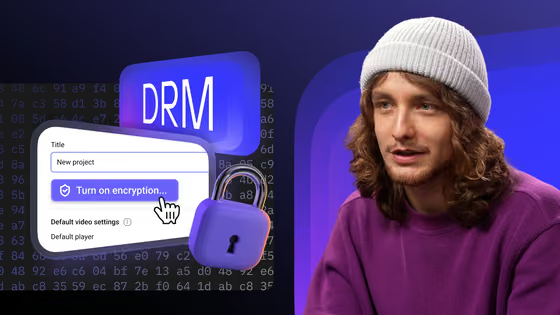
Serving one encrypted video library through several DRMDRMEncryption of the video file plus a licence server that issues a per-session key — so a downloaded copy stays unplayable.Open definition → systems at the same time — Widevine, FairPlay and, where it matters, PlayReady. Not a stronger kind of protection: the same protection, made to reach every device instead of some of them.
Multi-DRM runs Widevine, FairPlay and PlayReady side by side so one encrypted library plays everywhere — because Safari refuses Widevine and Chrome refuses FairPlay, no single system reaches every device.
What is multi-DRM?
Multi-DRM is the practice of protecting one video library with several DRMDRMEncryption of the video file plus a licence server that issues a per-session key — so a downloaded copy stays unplayable.Open definition → systems at once so that every viewer can play it. The file is encrypted a single time; what changes per platform is which licence server issues the key.
The name misleads slightly. Multi-DRM is not three locks on the same door — it is one lock cut to fit three different keyholes, because Google, Apple and Microsoft each built their own.
Why one system is never enough
The limitation is not in your player. Browsers refuse DRM systems they do not implement, and that refusal happens below anything your application controls.
| System | Owner | Where it plays | Usual pairing |
|---|---|---|---|
| Widevine | Chrome, Edge, Firefox, Android, most smart TVs | DASHDASHDynamic Adaptive Streaming over HTTP — an open ISO standard using .mpd manifests, common for DRM-protected premium content.Open definition → | |
| FairPlay | Apple | Safari, iOS, iPadOS, macOS, tvOS | HLSHLS (HTTP Live Streaming)Apple’s adaptive streaming protocol. Uses .m3u8 manifests and segmented delivery; supported on every browser, device and smart TV.Open definition → |
| PlayReady | Microsoft | Windows apps, Xbox, set-top boxes, some smart TVs | DASHDASHDynamic Adaptive Streaming over HTTP — an open ISO standard using .mpd manifests, common for DRM-protected premium content.Open definition → / Smooth |
Widevine and FairPlay together reach the overwhelming majority of consumer devices. PlayReady matters for living-room and Windows-app delivery.
The practical consequence is blunt. Protect a course with Widevine alone and every student on an iPhone gets an error instead of a lesson — and they will not report it as a DRM problem, they will report it as "your site is broken", or simply ask for a refund.
How one copy serves three systems
During transcodingTranscodingRe-encoding a source video into multiple resolutions and bitrates so a player can switch between quality levels on the fly.Open definition →, each rendition is encrypted using Common Encryption (CENC). One encrypted copy carries key identifiers that all three systems can read, so you do not store the library three times.
The player asks the browser which DRM systems it supports and picks one — FairPlay on Safari, Widevine nearly everywhere else.
The request goes to the licence server for that system. Your entitlement rules — who, how many devices, for how long — are applied in one place regardless of which system asked.
The key is handed to the platform's protected module. It never reaches your JavaScript, which is what separates DRM from obfuscation.
Widevine levels and your maximum resolution
One detail surprises teams after they switch DRM on: the resolutionResolutionThe pixel dimensions of a video frame — 480p, 720p, 1080p, 2160p (4K). Determines how sharp the picture looks on a given screen.Open definition → a viewer receives can drop, and nothing in your settings caused it.
Widevine grades devices by where decryption happens. L1 does it inside the hardware's trusted execution environment; L3 does it in software. Content owners commonly require L1 before allowing 1080p or 4K4K (2160p)Ultra HD at 3840×2160 — four times the pixels of Full HD, and the point where codec choice starts paying for itself.Open definition →, and cap L3 devices at 480p or 540p. The level belongs to the viewer's device — an old Android phone or a desktop Chrome without hardware support will be L3 no matter what you configure.
For paid courses and corporate video this rarely justifies a policy that punishes L3 viewers. Blocking them protects a file that was never studio-licensed, while a student on a three-year-old phone sees a blank player. Know the mechanism, then decide deliberately rather than inheriting a broadcaster's default.
What to check when buying multi-DRM
Vendors describe this market in near-identical language, so the differences are in the specifics:
"Multi-DRM" sometimes means Widevine plus an upsell. Ask which systems are on the plan you are quoted, not the platform's maximum.
Some vendors charge per licence request. On a course library with rewatching, that line grows faster than your storage bill.
Your backend should be able to authorise a licence request. If the only rules available are the vendor's presets, you cannot express "this student, this course, until their subscription lapses".
A clear message beats a spinning player. Ask what the viewer sees when their browser supports none of the systems on offer.
What multi-DRM does not solve
Multi-DRM widens coverage. It does not widen the threat model — the honest limits of DRMDRMEncryption of the video file plus a licence server that issues a per-session key — so a downloaded copy stays unplayable.Open definition → apply equally to one system or three.
| Threat | Covered? | What actually handles it |
|---|---|---|
| Downloading the file with an extension | Yes | Encryption — the copy is unplayable without a licence |
| Your embed re-hosted on another site | No | Domain restrictions, which live outside the encryption |
| Screen recording | Partly | Blocked where the OS allows; elsewhere a dynamic watermarkWatermarkingA mark burned into the frames. It prevents nothing — it makes a leaked copy point back at the account it came from.Open definition → makes it traceable |
| Capture card on the HDMI output | Partly | HDCPHDCPLink-level encryption between a video source and the display over HDMI or DisplayPort — the layer that blocks a capture card placed in between.Open definition →, negotiated on the display link |
| A phone filming the screen | No | Nothing prevents it — watermarking makes it attributable |
Further reading
- DRM — how the licence exchange works underneath.
- HDCP — the protection layer on the display cable.
- Watermarking — what covers the gap DRM leaves.
- Video tutorials — protection set up in the dashboard, on video.
- What is anti-piracy? — where DRM sits among the other methods.
- Video access control — domain, token and session rules.
- Secure video hosting — how Kinescope implements it.