
















Watermarking
A marker burned into the video itself. Unlike encryption it prevents nothing — its job is to make a leaked copy point back at the account it came from, which turns an anonymous act into an attributable one.
Watermarking stamps an identifying mark into the video frames themselves — a fixed logo, or a per-viewer ID — so it prevents no copying but makes a leaked recording traceable to the account it came from.
What is video watermarking?
Watermarking embeds an identifying mark into the picture. It survives screen recording, re-encodingTranscodingRe-encoding a source video into multiple resolutions and bitrates so a player can switch between quality levels on the fly.Open definition → and re-uploading, because it is part of the frames rather than metadata around them — which is exactly the point. Every other protection layer fails at the camera; this one keeps working.
It is worth being blunt about what that means: a watermark does not stop anybody. It changes the arithmetic for the person considering a leak, because the copy they hand over carries their own name.
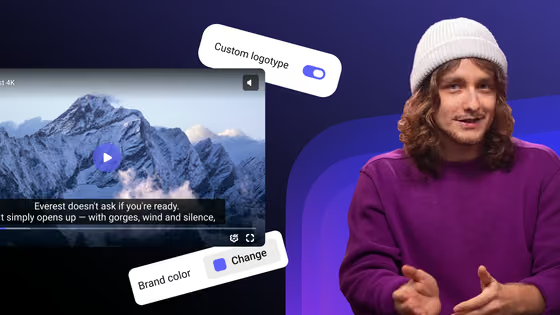
Kinescope renders both kinds: a static logo or text overlay, and a dynamic mark with the viewer's name, email or ID.
Static and dynamic watermarks
| Type | What it shows | What it is for |
|---|---|---|
| Static | Your logo or fixed text, identical for every viewer | Branding, and a mild deterrent against casual reposting |
| Dynamic (forensic) | The individual viewer's name, email or account ID | Attribution — tracing a specific leaked copy back to one account |
The distinction matters more than it sounds. A static mark tells the world whose content it is; a dynamic one tells you whose copy it is. Only the second changes anyone's behaviour, because only the second makes the leaker identifiable.
Dynamic marks are usually rendered by the player over the video, often drifting position so they cannot be reliably cropped out, independently of the resolutionResolutionThe pixel dimensions of a video frame — 480p, 720p, 1080p, 2160p (4K). Determines how sharp the picture looks on a given screen.Open definition → being served. Truly forensic schemes go further and encode the identifier into the pixel data itself, invisible to the eye and recoverable from a re-encoded copy.
How a per-viewer watermark works
When playback is authorised, your backend supplies whatever identifies the viewer — name, email, account ID, seat number.
That string becomes an overlay: position, opacity and movement pattern configured so it is readable in a recording but not intrusive to a paying viewer.
Because it is drawn over the video during playback, it appears in any screen capture, phone recording or re-upload made from that session.
When a copy surfaces, the mark names the account. That is usually enough to close the hole rather than guess at it.
What watermarking does and does not do
| Threat | Does watermarking help? | Why |
|---|---|---|
| Screen recording | Yes — the main case | The mark is in the frames, so it survives into the recording |
| A phone pointed at the monitor | Yes | The one attack no encryption touches; the mark still reads |
| Re-upload to another platform | Yes | Re-encoding does not remove a burned-in overlay |
| Downloading the original file | No | Nothing is prevented — that is what DRMDRMEncryption of the video file plus a licence server that issues a per-session key — so a downloaded copy stays unplayable.Open definition → is for |
| Sharing the playback link | No | Link control belongs to signed URLsSigned URLA playback link carrying an expiry and a cryptographic token — it stops working once the window closes, and a tampered link never works.Open definition → and domain rules |
Read the table as a division of labour rather than a scorecard. DRM stops the file being taken, signed links stop the URL being passed around, and watermarking covers the gap neither can reach — the moment a camera or a capture tool is pointed at a legitimate session.
Making it work in practice
A watermark only deters if viewers notice it. A mark hidden in a corner at five percent opacity satisfies a compliance checkbox and changes nobody's behaviour.
The viewer should be able to read their own email if they look for it. That is the whole deterrent.
A mark that drifts between positions cannot be cropped or masked out of a recording with a fixed rectangle.
Deterrence works before the leak. A line in the course terms noting that sessions are marked does more than any amount of opacity tuning.
Further reading
- Digital watermarking — Wikipedia — a vendor-neutral overview.
- DRM — the layer that protects the file rather than attributing the leak.
- How to stop video piracy — a practical guide for creators.
- Anti-piracy for video — how the layers combine.