


















1080p
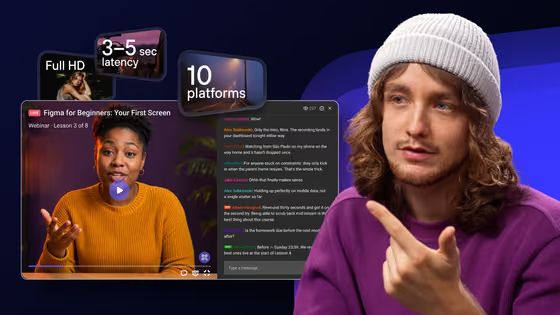
Full HD — 1920×1080, just over two million pixels per frame. The default target for web video, course lessons and sales pages, and the point where extra resolutionResolutionThe pixel dimensions of a video frame — 480p, 720p, 1080p, 2160p (4K). Determines how sharp the picture looks on a given screen.Open definition → stops paying for itself on most screens.
1080p, or Full HD, is 1920×1080 video — just over two million pixels per frame. It is the standard target for web, course and sales video, and enough resolution for almost every screen.
What is 1080p?
1080p is video with 1080 horizontal lines of pixels, drawn progressively — 1920×1080 in 16:9, or 2,073,600 pixels per frame. It is the resolution the industry settled on as "Full HD", to separate it from the 720p sets sold as merely "HDHD (High Definition)High definition — 720p and up, with 1080p as Full HD. The default quality most web and course video targets.Open definition → ready".
The older 1080i carries the same frame size but splits each frame into two interlaced fields. It survives in some broadcast chains; on the web, progressive is universal.
1080p dimensions
| Shape | Dimensions | Pixels per frame | Notes |
|---|---|---|---|
| 16:9 widescreen | 1920×1080 | 2,073,600 | The web and broadcast standard |
| 9:16 vertical | 1080×1920 | 2,073,600 | Reels, Shorts, TikTok-style formats |
| 1:1 square | 1080×1080 | 1,166,400 | Feed placements |
1920×1080 is also where "2K" confusion starts: cinema 2K is 2048×1080, slightly wider than Full HD, and the two labels are often used interchangeably in marketing.
Bandwidth and data
With H.264, 1080p typically needs 5–8 Mbps depending on how much motion is in the shot — roughly 2.25–3.6 GB per hour of viewing. Fast movement, grain and confetti push it higher; a static slide deck sits far below.
This is where codecCodecThe algorithm that compresses and decompresses video — H.264, H.265 (HEVC) and AV1 are the most common in modern streaming.Open definition → choice starts to pay real money: H.265 or AV1 hold the same quality at roughly half the bitrateBitrateThe amount of data used per second of video. Higher bitrate means more detail and a larger file; the core lever behind streaming quality.Open definition →, which at 1080p scale is a meaningful share of a delivery bill.
1080p against the rest of the ladder
| Label | Dimensions | Pixels | Against 480p |
|---|---|---|---|
| 360p | 640×360 | 230,400 | 0.56× |
| 480p (SD) | 854×480 | 409,920 | — |
| 720p (HD) | 1280×720 | 921,600 | 2.25× |
| 1080p (Full HD) | 1920×1080 | 2,073,600 | 5.06× |
| 2160p (4K)4K (2160p)Ultra HD at 3840×2160 — four times the pixels of Full HD, and the point where codec choice starts paying for itself.Open definition → | 3840×2160 | 8,294,400 | 20.2× |
1080p carries five times the pixels of 480p and 2.25 times those of 720p. The step up to 4K is another four times — for a difference most viewers only see on a large screen.
When 1080p is enough — and when it is not
For nearly all web video, 1080p is the sensible target. It is sharp enough for screen recordings with code or spreadsheets, cheap enough to deliver at scale, and universally supported.
4K earns its bandwidth when the content is watched on a big display from close up — product cinematography, live events on a TV.
Dense dashboards, CAD, or footage you expect people to zoom into keep more information at 2160p.
Courses, webinars, sales pages and social cuts. Past this point most viewers pay in loading time for detail they cannot see.
Whatever you target, upload the best source you have. A platform can transcode down but cannot invent detail that was never captured.
When DRM withholds 1080p
Encoding 1080p does not guarantee anyone receives it. Under DRM, the licence can carry an output condition, and the common studio-grade rule is that WidevineMulti-DRMServing one encrypted library through Widevine, FairPlay and PlayReady at once — no single DRM system covers every browser and device.Open definition → L1 — decryption inside the device\'s trusted hardware — is required before 1080p is released at all. Software-decrypting L3 devices are held at 480p480pStandard-definition video, 480 pixels tall — 854×480 in 16:9. The fallback rung of the adaptive ladder for slow or metered connections.Open definition → or 540p.
The result surprises teams that just switched protection on: the file is 1080p, the player is fine, and a slice of the audience quietly watches something blurrier. Nothing in the encoding settings caused it and nothing there will fix it.
For paid courses and internal training that strictness usually costs more than it protects. The policy is inherited from film distribution; a lesson recorded on a webcam is not a film release.
What 1080p costs against 720p
At 5–8 Mbps an hour of 1080p moves roughly 2.25–3.6 GB. At €0.03 per GB that is about 7–11 cents per viewing hour, a little over double 720p720pHigh definition at 1280×720 — 921,600 pixels per frame. The entry point to HD and the fallback rung below Full HD.Open definition →.
A thousand students through a ten-hour course: roughly €660–1,080 in delivery at 1080p against €330–540 at 720p. The question is whether the content spends those pixels. Screen recordings with code, spreadsheets or dense UI do — thin text breaks up at 720p. A talking head does not, and the second rung buys nothing but the invoice.
Further reading
- 1080p — Wikipedia — a vendor-neutral overview.
- Resolution — the full ladder, from 360p to 4K.
- 720p and 480p — the rungs below.