











Video access control
The rules that decide who may start a video, applied before a single frame is served. Not the same thing as DRMDRMEncryption of the video file plus a licence server that issues a per-session key — so a downloaded copy stays unplayable.Open definition →: access control governs who gets in, DRM governs what the bytes are worth once they arrive. Kinescope applies three such rules to a single video: an allowlist of approved domains, playback links signed with an expiry and an entitlement check from your own backend.
Video access control is the stack of pre-playback gates — approved domains, expiring signed links, tokens, geo and IP limits, passwords and SSO — that together decide whether a given viewer is allowed to start a stream.
What is video access control?
Access control is everything that happens before playback: the checks that decide whether this viewer, on this page, at this moment, is allowed to start the stream. It is a separate layer from encryption. DRMDRMEncryption of the video file plus a licence server that issues a per-session key — so a downloaded copy stays unplayable.Open definition → assumes the viewer got in and protects the file anyway; access control tries to stop the wrong viewer getting in at all.
Most leaks are not sophisticated. A course link forwarded to a group chat, an embed copied onto someone else's landing page, one login shared across a team — those are access-control problems, and they are cheaper to close than to trace after the fact.
On Kinescope, three of these layers combine on a single video: an allowlist of approved domains, playback links signed with an expiry, and an entitlement check from your own backend, which receives each playback request with the viewer's IP. SAML SSO is part of the Mega plan.
The controls, and what each one stops
| Control | Stops | Does not stop |
|---|---|---|
| Domain restriction | Your embed playing on a site you did not approve | Someone opening the stream URL directly |
| Signed URLSigned URLA playback link carrying an expiry and a cryptographic token — it stops working once the window closes, and a tampered link never works.Open definition → with expiry | Hotlinking and forwarded links, once the window closes | A download taken while the link is still valid |
| Token authentication | Access after entitlement is revoked in your own system | Sharing within an active, valid session |
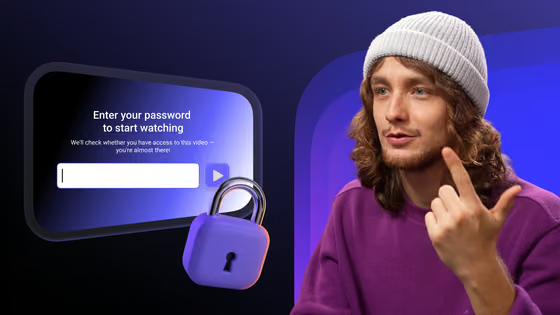
| Password / one-time code | Casual access by anyone without the code | The code being passed on with the link |
| Geo and IP limits | Playback outside a licensed territory or network | Anyone using a VPN |
| SSO | Access by anyone outside your directory | A logged-in user recording their screen |
Domain restriction and signed URLs cover the two most common leaks and cost the viewer nothing — no login, no friction.
Domain restriction, in practice
You give the platform a list of domains where the embed may run. The player checks the page it has been loaded into against that list, and refuses to play anywhere else. Copy the embed code onto another site and it shows a blocked player instead of your video.
This is the single most useful setting for anyone selling access to video, because the failure it prevents is the one that actually happens: an embed lifted from a sales page or a members area onto a site you have never heard of. It takes one setting and the legitimate viewer never notices it.
Its boundary is equally clear. Domain restriction governs the page, not the stream. Someone who opens the network tab and takes the media URL is outside its reach — that is what signed URLsSigned URLA playback link carrying an expiry and a cryptographic token — it stops working once the window closes, and a tampered link never works.Open definition → are for, and beyond them, DRMDRMEncryption of the video file plus a licence server that issues a per-session key — so a downloaded copy stays unplayable.Open definition →.
Token authentication versus a password
A password is a shared secret: once it travels, it works for everyone who has it, and you cannot take it back from one person. Token authentication moves the decision into your own backend. Your application asks "is this viewer entitled right now?", and only then does the player receive a short-lived token to exchange for playback.
The practical difference shows up at cancellation. With a password, a lapsed subscriber keeps watching until you rotate the password for everyone. With tokens, the next request simply fails, and nobody else is disturbed.
What to switch on first
One setting, closes the most common leak, invisible to real viewers. Start here regardless of what else you do.
Add when links get forwarded, or when the media URL is discoverable from the page.
Add when entitlement lives in your own product — subscriptions, seats, course enrolment.
Add when the file itself must be unusable off-platform, and when you need to know which viewer a leaked copy came from.
Skipping straight to DRM is a common and expensive mistake. DRM does nothing about an embed republished on another site — that is a domain rule, and it is free.
Further reading
- Video tutorials — a five-minute walkthrough of these controls in the product.
- Signed URL — how the expiring-link half works.
- DRM — what protects the file after access is granted.
- Watermarking — how a leak gets traced to a viewer.
- Private video hosting — the controls applied end to end.
- Video access control at Kinescope — domain, token and session rules.
- What is anti-piracy? — where access control sits among the other methods.