






















Widevine DRM
Google’s DRM: it encrypts the video and hands the key only to authorised players. Device security levels decide the highest quality they can play.
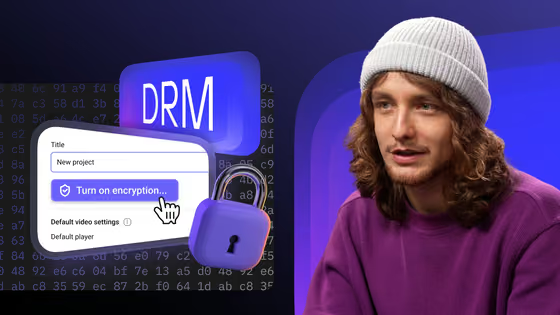
Widevine is Google’s DRM system: it encrypts the video and delivers the key only to authorised players, so a downloaded copy will not play. Security levels (L1, L3) decide how high a quality a device can play. Apple devices need FairPlay instead.
What is Widevine?
Widevine is a digital rights management technology Google acquired in 2010 that is built into Chrome, Firefox, Edge, Android, Android TV and many smart TVs. When a video is protected with Widevine, the file travelling over the internet is encrypted: even if someone downloads it, it will not play without a licence.
It is the layer that makes it possible to sell courses, stream sport or publish series without the content ending up in a download group. It does not replace watermarkingWatermarkingA mark burned into the frames. It prevents nothing — it makes a leaked copy point back at the account it came from.Open definition → or access controlVideo access controlThe rules that decide who may start a video: approved domains, expiring signed links, geo and IP limits, passwords, one-time codes and SSO.Open definition →, but it is the only one that stops a copy from playing.
How it works
The platform encrypts every rendition with a key. What the CDNCDN (Content Delivery Network)A global network of edge servers that caches video close to viewers, cutting latency and absorbing traffic spikes.Open definition → delivers is encrypted segments.
When playback starts, the Widevine module in the browser or device asks the licence server for a licence, and the server checks the viewer is allowed.
The key goes to the decryption module, never to the page’s code, and the video is decrypted frame by frame as it plays.
Security levels: L1, L2 and L3
| Level | Where decryption happens | Typical quality | Examples |
|---|---|---|---|
| L1 | In the device’s secure hardware | The full ladder, up to HD and 4K | Most current Android phones, smart TVs |
| L2 | Partly in hardware | Intermediate | Rare |
| L3 | In software | Often limited to 480p or 540p | Older Android phones, desktop Chrome without hardware support |
The level depends on the viewer’s hardware, not on how you encode the video. If a protected course looks low quality on one laptop, it is almost always an L3 device.
Widevine, FairPlay and PlayReady
| System | Company | Where it works |
|---|---|---|
| Widevine | Chrome, Firefox, Edge, Android, Android TV | |
| FairPlay | Apple | Safari, iOS, iPadOS, macOS, Apple TV |
| PlayReady | Microsoft | Edge on Windows, Xbox, some smart TVs |
No single system covers every device. Serving one library with several at once is called multi-DRMMulti-DRMServing one encrypted library through Widevine, FairPlay and PlayReady at once — no single DRM system covers every browser and device.Open definition →; Widevine and FairPlay together cover the vast majority of consumer devices.
Further reading
- Kinescope: DRM encryption — turning on Widevine and FairPlay.
- DRM — how digital rights management works in general.