

















Origin shield and tiered caching
The cache layer between the CDN’s edges and your origin — the reason a premiere with thousands of viewers produces one request to your server, not thousands.
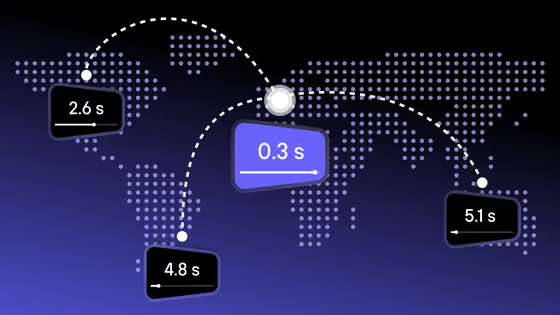
Tiered caching puts a regional shield cache between the edges and the origin, so when many edges miss the same video segment, only one request goes back to the origin — keeping it fast, cheap and standing during a traffic spike.
What is an origin shield?
An origin shield is an extra caching tier that sits between a CDNCDN (Content Delivery Network)A global network of edge servers that caches video close to viewers, cutting latency and absorbing traffic spikes.Open definition →’s edge servers and the origin, where the master copy of your video lives. When an edge does not have a segment, it asks the shield instead of the origin. If the shield has it, the origin is never touched; if not, the shield fetches it once and serves every edge that asked.
A CDN arranged this way uses tiered caching (also called multi-layered or hierarchical caching): edges near viewers, one or more regional or shield tiers behind them, and the origin last. For video this matters more than for web pages, because one video turns into thousands of small segment files and a popular stream requests them from everywhere at once.
How multi-layered caching works
The player asks the nearest edge for the next segment of the rendition it is playing.
On a hit, the edge answers immediately. On a miss, it forwards the request to the shield instead of the origin.
If ten edges miss the same segment at the same moment, the shield merges their requests and fetches the segment from the origin once.
The segment is stored at the shield and at each edge, so the next viewer in every region gets a hit.
The number to watch is the cache hit ratio — the share of requests answered from cache. Each extra tier raises it, because the shield sees requests from many edges and is far more likely to already hold a segment than any single edge.
What gets cached, and for how long
| Object | Changes? | Caching approach |
|---|---|---|
| VoD segments | Never, once written | Long cache lifetime; versioned URLs |
| VoD manifest | Rarely | Long lifetime, purged on re-encode |
| Live segments | Never, once written | Cached as soon as they appear |
| Live playlist | Every few seconds | Very short lifetime, or held requests for LL-HLSLow-Latency HLS (LL-HLS)Apple’s HLS extension that publishes partial segments and holds playlist requests, cutting live delay from 10–30 seconds to a few.Open definition → |
| Signed playback URLs | Per viewer | Cache key ignores the token, so one object serves all |
Packaging matters too: with CMAFCMAF (Common Media Application Format)One fragmented-MP4 packaging that HLS and DASH can both play — a single set of segments for every device and the base of low-latency live.Open definition →, HLS and DASH share one set of segments, so the cache holds one object instead of two.
Why it matters during traffic peaks
- Premieres and live events. A new video is cold everywhere. Without a shield, thousands of viewers can turn one missing segment into thousands of identical origin requests at the same second.
- Origin load and cost. Fewer origin fetches mean a smaller origin and less data leaving it — on public clouds, fewer egress feesEgress feesWhat a provider charges per GB of data leaving its network. For video it grows with watch time, so bitrate, caching and per-GB price set the bill.Open definition →.
- Long-tail libraries. Rarely watched lessons are rarely at a given edge, but often still at the shield, so their first viewer in a region does not wait for the origin.
- Distance. A shield close to the origin keeps long-haul fetches to one per segment rather than one per edge per segment.
Further reading
- What is a video CDN? How it works and when you need one — edges, shields, cold caches and how to read a CDN bill.
- Best video CDN providers in 2026 — how delivery platforms compare.